Introduction
Lung cancer is an increasingly prevalent malignancy and a leading cause of cancer-related deaths worldwide. In 2018, there were an estimated 2.1 million new cases and 1.76 million deaths due to lung cancer [1]. The number of lung cancer-related deaths is projected to continue rising, with an estimated global mortality of 1.97 million by 2025 and 2.95 million by 2035 [1,2]. In Indonesia, lung cancer ranks first in cancer-related mortality, with 30,843 deaths reported in 2020. In terms of incidence, it ranks third, with 34,783 new cases diagnosed [3].
Lung cancer is classified into two major types based on tumor morphology and clinical management: Non-Small Cell Lung Cancer (NSCLC) and Small Cell Lung Cancer (SCLC). NSCLC is further subcategorized based on tumor cell differentiation into adenocarcinoma, Squamous Cell Carcinoma (SCC), and large cell carcinoma. SCLC, characterized by neuroendocrine differentiation, exhibits distinct features in progression, prognosis, and etiology when compared to other small cell neuroendocrine tumors arising outside the lungs [4–6].
Multiple studies have demonstrated an association between lung cancer histological type and patient survival outcomes [7– 10]. One such study by Girones et al. (2015), a single-center study using hospital registry data from 2004 to 2014, also reported a significant relationship between histological type and survival [11].
A 2019 study conducted at Dharmais Cancer Hospital, the National Cancer Center of Indonesia, identified Non-Small Cell Lung Cancer (NSCLC)—particularly the adenocarcinoma subtype—as the most common histological type of lung cancer [12]. However, to date, no study has reported patient survival outcomes based on lung cancer histology at Dharmais Cancer Hospital. Therefore, the aim of this study is to evaluate and compare the survival outcomes of patients with NSCLC and Small Cell Lung Cancer (SCLC) according to histological classification.
This study benefits from a large sample size of 949 patients, which provides substantial statistical power to detect differences in prognosis between NSCLC and SCLC groups. The inclusion of a large and representative clinical population enhances the external validity of the findings. Moreover, this study offers valuable insights into the clinical characteristics and survival outcomes of lung cancer patients in a national cancer center setting, while also allowing for a more detailed analysis of prognostic factors influencing clinical outcomes.
Materials and methods
Study design
This single-center, retrospective cohort study was conducted at Dharmais Cancer Hospital. Patients were eligible for inclusion if they met the following criteria: 1) The date of first diagnosis was between January 1, 2012, and December 31, 2017; 2) They were diagnosed with primary lung cancer according to the third edition of the International Classification of Diseases for Oncology (ICDO-3), topography codes ICD-10: C34.0–C34.9.
Patients were excluded if they met any of the following criteria:
1) A diagnosis of primary lung cancer other than SCLC or NSCLC;
2) A diagnosis of a lung mass consistent with granulomatous diseases such as tuberculosis; 3) A clinical or radiological diagnosis of lung metastases originating from malignancies in other organs.
This study was approved by the Ethics Committee of Medical Research, Dharmais Cancer Hospital (No. 184/KEPK/V/2023).
Data collection
Data for this study were obtained from the hospital-based lung cancer registry, encompassing cases diagnosed between 2013 and 2017. The registry provided comprehensive information, including patient demographics (age and sex), histopathological classification (confirmed by pathological examination and categorized according to the World Health Organization criteria for lung and pleural tumors), and clinical variables such as stage at diagnosis and treatment modalities received. Cancer staging was performed according to the 7th edition of the American Joint Committee on Cancer (AJCC) TNM classification system. Treatment modalities recorded included surgery, chemotherapy, radiotherapy, and targeted therapy.
To ensure adequate statistical power, the minimum required sample size was calculated using the Lemeshow formula. The calculation assumed a significance level of 5% (α=0.05), a statistical power of 80% (1-β=0.80), and estimated proportions of death among patients with Non-Small Cell Lung Cancer (NSCLC) and Small Cell Lung Cancer (SCLC) of 0.61 and 0.74, respectively, based on published data (He et al., 2022). The resulting minimum sample size was 942 participants. As the registry contained all eligible cases within the study period, a total sampling approach was employed, and the available sample exceeded the minimum calculated requirement.
Follow up of enrolled lung cancer patients
All patients were followed up until December 31, 2021. For deceased patients, the date of death recorded in the hospital registry was used. Survival time was defined as the interval between the date of diagnosis and the date of last contact or death.
Statistical analysis
The 5-year cumulative survival rates for each histological type were estimated using the Kaplan–Meier method, and differences between survival curves were tested using the log-rank test. Since all variables met the assumptions of the Cox proportional hazards model, multivariate analysis was subsequently performed using Cox regression to identify prognostic factors for lung cancer at Dharmais Cancer Hospital. All statistical analyses were conducted using STATA version 13.
Results
Characteristics of the enrolled lung cancer patients
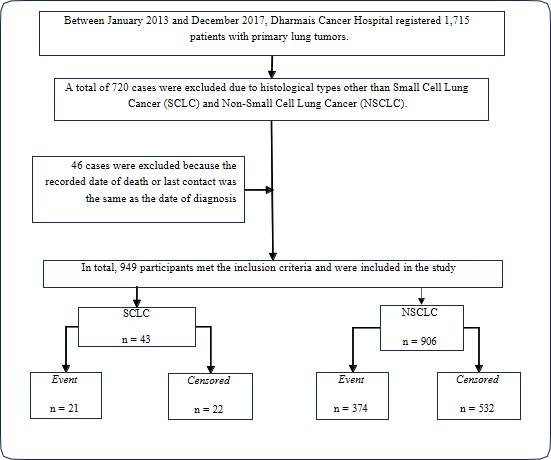
After applying the inclusion and exclusion criteria and considering the dates of diagnosis and last contact, 949 patients were included in the study: 43 with SCLC and 906 with NSCLC.
In Figure 1, a total of 1,715 lung cancer cases were diagnosed at Dharmais Cancer Hospital between 2013 and 2017. Of these, 720 cases were excluded due to histological types other than SCLC and NSCLC. An additional 46 cases were excluded because the date of diagnosis was identical to the date of death or last contact. As a result, 949 eligible cases were included as research samples. In this study, an event is defined as a lung cancer-related death, while censoring refers to cases lost to follow-up.
Table 1 presents the characteristics of lung cancer patients at Dharmais Cancer Hospital. The majority of patients were under 60 years old (59.01%), male (71.02%), diagnosed at an advanced stage (35.62%), and did not receive treatment (50.05%). When analyzed by histological type, SCLC patients were predominantly under 60 years of age (51.16%), male (81.40%), at an advanced stage (39.53%), and had received treatment (51.16%). In contrast, NSCLC patients were mostly under 60 years old (59.38%), male (70.53%), at an advanced stage (35.43%), and had not received treatment (50.11%).
It is important to note that performance status data were unavailable, as these details were not documented by the attending physicians during the study period.
Table 1: Characteristics of Lung Cancer Patients at Dharmais Cancer Hospital Based on Histology of SCLC and NSCLC.
| Characteristics |
Total (%) |
Histology |
| SCLC (%) |
NSCLC (%) |
Survival
• Event
• Censored |
395(41,62)
554(58,38) |
21(48,84)
22(51,16) |
374(41,28)
532(58,72) |
Age
• ≥60 years
• <60 years |
389(40,99)
560(59,01) |
21(48,84)
22(51,16) |
368(40,62)
538(59,38) |
Gender
• Male
• Female |
674(71,02)
275(28,98) |
35(81,40)
8(18,60) |
639(70,53)
267(29,47) |
Clinical staging
• Advanced (III-IV)
• Early (I-II)
• Unknown |
338(35,62)
10(1,05)
601(63,33) |
17(39,53)
1(2,33)
25(58,14) |
321(35,43)
9(0,99)
576(63,58) |
Therapy
• No therapy
• Therapy conducted |
475(50,05)
474(49,95) |
21(48,84)
22(51,16) |
454(50,11)
452(49,89) |
Table 2: Survival analysis of lung cancer based on histological subgroups.
| Variable |
Sample size |
3-year OS rate |
P-Value† |
| SCLC (n=43) |
SCLC (n=906) |
SCLC (CI 95%) |
NSCLC (CI 95%) |
|
Age
• ≥60 years
• <60 years |
21
22 |
368
538 |
35,7% (6,8-67,3)
18,8% (3,4-43,7) |
15,6% (7,8-26,0)
20,5% (14,2-27,7) |
0,82 |
Gender
• Male
• Female |
35
8 |
639
267 |
29,3% (10,1-51,8)
21,8% (0,9-61,2) |
18,1% (11,8-25,5)
19,2% (10,8-29,4)
| 0,16 |
Clinical staging
• Advanced
• Early
• Unknown
| 17
1
25 |
321
9
576 |
21,5% (3,8-48,6)
100,0%
28,3% (5,6-57,6) |
18,1% (8,9-30,0)
68,5% (21,2-91,2)
17,5% (11,4-24,6) |
0,08 |
Therapy
• No therapy
• Therapy conducted |
21
22 |
454
452 |
32,6% (6,4-63,4)
25,8% (6,9-50,4) |
17,9% (8,6-30,0)
18,7% (12,6-25,8) |
<0,01 |
| Overall |
949 |
17,8% (12,7–23,5%) |
|
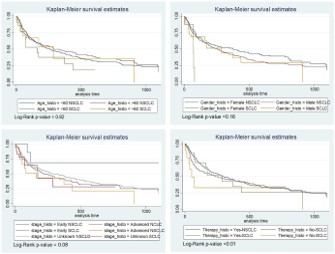
Table 2 presents data on lung cancer cases diagnosed from 2013 to 2017. Outcomes were observed over a three-year period. The overall median survival was 720 days. The three-year overall survival rate was 17.8%. Table 2 also summarizes the associations between various covariates and lung cancer survival. Significant differences in survival were found across age groups, gender, and clinical stage (P-value<0.05). In contrast, the type of therapy did not show a statistically significant difference in survival outcomes between its categories (P-value>0.05).
Among patients with Small Cell Lung Cancer (SCLC), survival rates were analysed using the Kaplan-Meier method. Patients younger than 60 years had a survival rate of 18.8% (95% CI: 6.8–67.3%), which was lower than the 35.7% (95% CI: 3.4–43.7%) observed in patients aged 60 and above. When comparing genders, female patients had a survival rate of 21.8% (95% CI: 0.9–61.2%), while male patients had a slightly higher rate at 29.3% (95% CI: 10.1–51.8%). Survival also varied by clinical stage. Patients with advanced-stage disease had a survival rate of 21.5% (95% CI: 3.8– 48.6%), compared to 100.0% for those with early-stage disease, and 28.3% (95% CI: 5.6–57.6%) for those with unknown stage. Interestingly, patients who received therapy had a slightly lower survival rate than those who did not, at 25.8% (95% CI: 6.9–50.4%) versus 32.6% (95% CI: 6.4–63.4%).
For patients with Non-Small Cell Lung Cancer (NSCLC), the survival rate was 20.5% (95% CI: 14.2–27.7%) for those under 60 years, and 15.6% (95% CI: 7.8–26.0%) for those aged 60 and above. Male patients had a survival rate of 18.1% (95% CI: 11.8– 25.5%), which was slightly lower than the 19.2% (95% CI: 10.8– 29.4%) observed in female patients. Survival was notably lower among patients diagnosed at advanced stages (Stage III–IV), with a rate of 18.1% (95% CI: 8.9–30.0%), compared to 68.5% (95% CI: 21.2–91.2%) in those with early-stage disease (Stage I–II). Patients with unknown clinical stage had a survival rate of 17.5% (95% CI: 11.4–24.6%). Furthermore, patients who received therapy had a slightly better survival rate than those who did not, at 18.7% (95% CI: 12.6–25.8%) compared to 17.9% (95% CI: 8.6–30.0%).
Relationship between SCLC and NSCLC histology on survival of lung cancer patients
Table 3 presents the results of the Cox regression analysis, showing the hazard ratios for lung cancer patients based on histological type, both unadjusted and adjusted for covariates. The crude analysis indicates that patients with SCLC have a higher risk of mortality compared to those with NSCLC (HR=1.426, 95% CI: 0.918–2.215). After adjusting for age, gender, clinical stage, and treatment, the risk remains elevated for SCLC patients (HR=1.355, 95% CI: 0.870–2.112). Although these findings suggest an increased likelihood of mortality for SCLC patients, the confidence intervals include 1, indicating that the results are not statistically significant.
Table 3: Cox regression analysis of the association between SCLC and NSCLC histology and survival in lung cancer patients.
| Variable |
Prevalence (%) |
Crude HR |
Adjusted HR |
| Histology |
|
|
|
| NSCLC |
95,47 |
Reff |
Reff |
| SCLC |
4,53 |
1,426 |
1,355 |
Discussion
In this study, 949 lung cancer patients were diagnosed at Dharmais Cancer Hospital (DCH) between 2013 and 2017. Of these, 95.5% had Non-Small Cell Lung Cancer (NSCLC), while only 4.5% had Small Cell Lung Cancer (SCLC). This predominance of NSCLC is consistent with findings from other countries. For example, a multicenter hospital-based study in China reported that among 7,311 lung cancer patients, 67.6% had NSCLC, 12.8% had SCLC, and 20% had other or unknown histological types [1]. Similarly, the Korean Association of Lung Cancer Registry found that, among 2,657 patients, 79.0% had NSCLC and 13.0% had SCLC. These data highlight the global trend of NSCLC being the most common type of lung cancer [2].
Regarding age, the majority of patients in our study were under 60 years old, with a male-to-female ratio of 2.5:1. This differs slightly from a previous study at DCH (2008–2012), which found more patients aged 60 years or older. However, the gender distribution remained similar, with both studies showing a higher proportion of male patients (male-to-female ratio of 3:1 in the earlier study) [3].
When examining clinical stage at diagnosis, we found that 63.3% of cases had an unknown clinical stage. Among those with recorded stages, most patients presented with advanced disease (stage III or IV, 35.6%), while early-stage cases (stage I or II) were rare (1.1%). These findings are similar to those reported by Ramadhaniah et al. (2019) at DCH, which also noted a high proportion of unknown stages (57.1%) and a similar distribution of advanced (39.7%) and early-stage (3.6%) cases [3]. The large proportion of missing stage data in our study suggests that, as of 2017, DCH lacked a robust system for ensuring complete documentation of clinical stage in patient records. In contrast, a study by He et al. (2022) in China demonstrated more complete staging, with 19.2% of patients at stage I, 6.7% at stage II, 25.8% at stage III, and 48.2% at stage IV. This suggests that more comprehensive record-keeping can significantly improve data quality for clinical staging [1].
From a treatment perspective, half of the patients in our study (50.1%) did not receive any therapy. Among these untreated patients, fewer experienced events (such as death) compared to those who were censored. There was a statistically significant difference in survival between treated and untreated patients (p<0.05), with untreated patients having a 1.27 times higher risk of experiencing an event. This is in contrast to the study by He et al. (2022), where only 13.0% of patients did not receive treatment, and 86.3% did. Similar results were reported in a Mayo Clinic study by Sun et al. (2006), where 14.4% of patients were untreated [1,5]. The higher proportion of untreated patients in our study may be related to the advanced stage at diagnosis and poor performance status, which limited treatment options.
Our study also found that SCLC patients had lower survival rates and shorter median survival times compared to NSCLC patients. However, bivariate analysis revealed no statistically significant difference in survival between SCLC and NSCLC patients (p>0.05). This result remained unchanged after adjusting for age, gender, clinical stage, and treatment (p>0.05). In contrast, He et al. (2022) reported a significant association between histological type and survival (p<0.01) [1]. The difference in findings may be due to sample size, as the study by He et al. included 7,311 patients from 17 hospitals across six provinces, with follow-up until 2020. Their larger sample size likely provided greater statistical power to detect differences in survival between SCLC and NSCLC.
Likewise, a study by Jeon et al. (2023) using the Korean Association of Lung Cancer Registry (KALC-R) also found significant survival differences between histological subtypes, particularly for the adenocarcinoma subtype of NSCLC [2]. In their study, only 7% of SCLC patients survived during the follow-up period, and most deaths occurred in those with extensive disease, underscoring the impact of disease stage on survival. The differences between our findings and those from larger cohort studies may be due to variations in sample size and the censoring process, which could have resulted in some participants being misclassified as censored rather than as having experienced an event.
Conclusion
This study reveals that, overall, SCLC patients at Dharmais Cancer Hospital have lower survival compared to NSCLC patients. However, after adjusting for key clinical and demographic factors, the difference in survival between SCLC and NSCLC was not statistically significant.
Declarations
Conflict of interest: The authors declare no conflicts of interest related to this study. The design, implementation, analysis, and reporting of this research were carried out independently, without any influence from external parties.
Funding sources: This study did not receive any external funding or sponsorship. All research expenses were covered by the authors themselves.
Acknowledgements: We would like to express our sincere gratitude to everyone who contributed to this research, including the Indonesian Cancer Registry, Dharmais Cancer Center, and the Faculty of Public Health at the University of Indonesia.
Approval: This study was conducted as part of a master’s thesis in clinical epidemiology at the Faculty of Public Health, Universitas Indonesia; and received ethical approval from both the Ethics Committee of Dharmais Cancer Hospital and the Ethics Committee of the Faculty of Public Health, Universitas Indonesia. The approval confirms that the research followed ethical standards for studies involving human participants, including maintaining confidentiality, obtaining informed consent, and addressing all relevant ethical considerations. Approval from these committees affirms the academic and clinical integrity of the study.
Ethical declaration: This study was conducted in accordance with ethical principles and received approval from the Ethics Committee of Dharmais Cancer Hospital and the Ethics Committee of the Faculty of Public Health, Universitas Indonesia.
Authors contribution: The Board of Directors at Dharmais Cancer Hospital provided institutional support and facilitated access to essential resources. The Multidisciplinary Pulmonology Oncology Team contributed clinical expertise in lung cancer management and provided critical clinical data. Pathologists played a key role in verifying the histological diagnoses of lung cancer cases. The Cancer Burden Data Controllers and Cancer Networkers at Dharmais Cancer Hospital and the Indonesia National Cancer Center supported data collection and ensured the accuracy and completeness of patient information used in this study.
References
- Wild CP, Weiderpass E, Stewart BW. World Cancer Report 2020. Cancer Control. Lyon, France: International Agency for Research on Cancer. 2020; 613.
- Didkowska J, Wojciechowska U, Mańczuk M, Lobaszewski J. Lung cancer epidemiology: Contemporary and future challenges worldwide. Ann Transl Med. 2016; 4: 1–11.
- IARC WHO. Indonesia Global Cancer Observatory. Vol. 858, Globocan. 2020.
- Nicholson AG, Tsao MS, Beasley MB, Borczuk AC, Brambilla E, Cooper WA, et al. The 2021 WHO Classification of Lung Tumors: Impact of Advances Since 2015. J Thorac Oncol. 2022; 17: 362–87.
- Rodak O, Peris-Díaz MD, Olbromski M, Podhorska-Okołów M, Dzięgiel P. Current landscape of non-small cell lung cancer: Epidemiology, histological classification, targeted therapies, and immunotherapy. Cancers (Basel). 2021: 13.
- Yang Y, Wang G, He J, Ren S, Wu F, Zhang J, et al. Gender differences in colorectal cancer survival: A meta-analysis. Int J Cancer. 2017; 141: 1942–9.
- Sun Z, Aubry MC, Deschamps C, Marks RS, Okuno SH, Williams BA, et al. Histologic grade is an independent prognostic factor for survival in non-small cell lung cancer: An analysis of 5018 hospitaland 712 population-based cases. J Thorac Cardiovasc Surg. 2006; 131: 1014–20.
- Warth A, Muley T, Meister M, Stenzinger A, Thomas M, Schirmacher P, et al. The novel histologic International Association for the Study of Lung Cancer/American Thoracic Society/European Respiratory Society classification system of lung adenocarcinoma is a stage-independent predictor of survival. J Clin Oncol. 2012; 30: 1438–46.
- Tsai HC, Huang JY, Hsieh MY, Wang BY. Survival of Lung Cancer Patients by Histopathology in Taiwan from 2010 to 2016: A Nationwide Study. J Clin Med. 2022: 11.
- He S, Li H, Cao M, Sun D, Yang F, Yan X, et al. Survival of 7, 311 lung cancer patients by pathological stage and histological classification: a multicenter hospital-based study in China. Transl Lung Cancer Res. 2022; 11: 1591–605.
- Gironés R, López P, Chulvi R, Cañabate M, Dolores T. Ten years of lung cancer in a single center: gender, histology, stage and survival. J Cancer Metastasis Treat. 2015; 1: 201.
- Ramadhaniah F, Khairina D, Sinulingga DT, Suzanna E, Jayusman AM. Distribution of Lung Cancer Patients in Dharmais Cancer Hospital Year 2008-2012. J Respirologi Indones. 2019; 39: 31–6.
- Jeon DS, Kim HC, Kim SH, Kim TJ, Kim HK, Moon MH, et al. Five-Year Overall Survival and Prognostic Factors in Patients with Lung Cancer: Results from the Korean Association of Lung Cancer Registry (KALC-R) 2015. Cancer Res Treat. 2023; 55: 103–11.