Childhood cancer and its impact in pediatric health
Childhood cancer is a challenge in global health. It is a major cause of mortality for children and adolescents, with approximately 300,000 new cases globally per year and survival rates that vary wildly between low-to-middle-income countries and high-income countries [1]. Despite a lower incidence rate compared to adults, childhood cancer is the second leading cause of death in children over five worldwide [2]. In Latin America and the Caribbean, more than 29,000 children and adolescents below the age of 19 are affected by cancer each year, and around 10,000 deaths are attributable to this condition [2,3]. In Chile, the reported incidence is 142.3 per million children under the age of 15, with a 78.4% survival rate at 5 years post diagnosis [4], comparable to survival rates documented in high income countries. This is a remarkable achievement, considering that survival rates in Latin America can be as low as 20%, with an average survival rate of 55% in the region [5]. The improvement in childhood cancer outcome, as suggested by literature, is attributable to the implementation of national childhood cancer programs, which have established standards of care, fostered professional training, and promoted rigorous research [6].
In our country, the «Programa Infantil Nacional de Drogas Antineoplásicas» (PINDA), was established in 1988. This program has standardized the management of pediatric cancer across major public institutions, covering more than 80% of treated children throughout the country. Moreover, the “Plan nacional de cáncer infanto-adolescente 2023-2028” highlights various work areas to further enhance both child and adult cancer outcomes in Chile, including international collaboration and promotion of robust research [7,8].
Infectious complications in children with cancer
Infections represent one of the main causes of morbidity and mortality in this population [9]. Pediatric cancer patients are at high risk of severe infections due to the disruption of their impaired immune response, disturbance of the mucocutaneous barriers and neutropenia induced by chemotherapy regimens [10,11]. The most frequent and relevant clinical situation from an infectious perspective is Febrile Neutropenia (FN) [12]. Children in treatment for cancer have an average of 6 to 8 episodes of FN during the usual two years of chemotherapy, requiring in each episode hospitalization, prolonged Antimicrobial (AM) therapy, laboratory tests, imaging and eventually hospitalization in Critical Care Units. Episodes of FN usually delay chemotherapy cycles, are associated with drug interactions, toxicity and increase in AM Resistance (AMR) [13,14]. Notwithstanding the improvements in pediatric cancer treatments and diagnosis, a significant proportion of patients are still exposed to broad spectrum AM therapy to treat episodes of FN, increasing the use of broad-spectrum AMs by up to 47% [15], favoring the selection of resistant strains [16].
The global burden of antimicrobial resistance
The future of life on earth is currently threatened by AMR and its risk to human health [17]. AMR was prioritized by the World Health Organization (WHO) as one of the top ten global public health threats and the UN General Assembly on AMR in 2016 officially declared the relevance of this problem and encouraged countries to work on their individual AMR National Action Plans [18].
Only on 2019 there were near to 5 million deaths related to AMR and 1.27 million deaths directly attributable to AMR infections, exceeding deaths attributable to tuberculosis, malaria and HIV/AIDS [18].
AMs are a global asset to public health, deeply embedded in our capacity to reduce maternal and child mortality, to end extreme poverty and promote shared prosperity, end hunger, healthy lives and well-being as well as, to achieve sustainable and inclusive economic growth [18]. In this context, the World Bank (WB) has established that AMR poses a threat not only to public health but to economic prosperity, recognizing the role of AMs in the management of various diseases, as well as their involvement in agricultural and food systems for crop and livestock care, estimating that by 2050 uncontrolled AMR could decrease global gross domestic product by 3.8% per year and force 28 million people into poverty [19].
AMR development is known to be related to use and misuse of AM [20]. The positive impact of AM can be threatened by increase of AMR and lack of access to essential therapies in low and middle-income countries [21].
Antimicrobial resistance in pediatric population
In recent decades, the pediatric population has become the focus in battle against AMR. Children are the primary consumers of AM [22-24]. In 2019, it was estimated that 20% of deaths caused by AMR occurred in children under 5 years old. In Europe, around 30% of infections are caused by resistant bacteria, increasing in low and middle-income countries [22]. Overconsumption of AMs is one of the primary causes of AMR in pediatrics, where AM are unnecessary prescribed for diagnoses of viral infections, particularly in outpatient setting [25].
The Worldwide AM Resistance and Prescribing in European Children described the global use of AM in pediatric patients, with a high consumption of empirical broad-spectrum AM treatments. Moreover, the improper use of AMs in this population is favored by the lack of studies and dosage definition specifically for pediatric patients, where the pharmacokinetics and pharmacodynamics of AM may be altered, leading bacterial exposure to subtherapeutic doses and selecting resistant strains, increasing the issue of Multi Drug Resistance (MDR) [23,24].
Antimicrobial resistance in children with cancer
Cancer patients are known to be susceptible to Blood Stream Infections (BSI), particularly due to frequent hospital admissions, exposure to broad spectrum AMs, effects of chemotherapy on mucosal barriers and invasive procedures as well as use of central venous catheters [22-24].
In recent years, there has been a rise in AMR rates among children with cancer, primarily due to MDR Gram-negative bacilli, associated with hospital admission more than 48 hours, recent administration of empiric or targeted AMs, severe neutropenia, periods of neutropenia longer than 7 days, and ciprofloxacin prophylaxis [26,27]. A single center, retrospective study included 607 children with cancer and BSI, showed that the most frequently identified microorganisms were Escherichia coli (28%) and Klebsiella pneumoniae (12.2%), with a high resistance to piperacillin/ tazobactam, levofloxacin, and meropenem and a low resistance to colistin and tigecycline [28]. On a recent report, Castagnola et al. described 797 Gram-negative resistant strains from 1031 patients, out of 1291 BSIs, in a group of pediatric patients undergoing chemotherapy or hematopoietic cell transplantation in 13 centers worldwide, showing that the presence of resistant strains was correlated with a higher risk of Intensive Care Unit admission and a higher risk of death [29]. An analysis of AMR in isolates from children with cancer in Chile in the period 2016-2021, showed that among Gram-negative bacilli, there was 37% resistance to cefotaxime, 18% to piperacillin/tazobactam, 8% to amikacin, and 1.4% to carbapenems [30]. This presents a challenging scenario due to the high mortality associated with these difficult-to-treat infections and the lack of new AM treatment alternatives to combat infections by MDR microorganisms.
Tacking the gaps in the rational antimicrobial management in pediatric patients with cancer. Antimicrobials stewardship in children with cancer and episodes of fever and neutropenia: The experience of a middle-income country
In recent years, our group conducted a prospective, multicenter, government sponsored study with the aim to compare efficacy and safety of different AM stewardship strategies with current standard AM treatments in episodes of FN in children with cancer,in 8 hospitals belonging to the PINDA network across the country. Our main results were: We validated the efficacy and safety of withdrawing AM therapy in children with cancer and FN with a demonstrated viral respiratory tract infection. Children who were positive for a respiratory virus and negative for a bacterial pathogen, were randomized to either maintain or withdraw AM therapy; 139 children were randomized, 70 to withdraw and 69 to maintain AM therapy. The group with the intervention showed shorter AM treatment: a median of 5 days (IQR 3-6) versus 3 days (IQR 3-6) (p<0.001) and a similar uneventful resolution: 66/70 (94%) versus 66/69 (96%), RR 1.01; (95% CI 0.93 to 1.09), absolute risk difference 0.01; (95% CI, 0.05 to 0.08) [31]; we demonstrated the efficacy and safety of using narrow AM treatment compared to the standard AM treatment in children with cancer and FN episodes categorized as fever of unknown origin (FUO); and we demonstrated the efficacy and safety of using a narrow AM treatment compared to the standard AM treatment in children with cancer and FN episodes with a demonstrated BSI (Unpublished data).
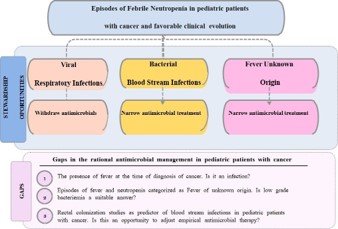
According to the results of the aforementioned studies, we introduced the following three new indications in the clinical management of children with cancer and episodes of FN, treated in the PINDA network, as shown in Figure 1: 1) Withholding AM therapy in children with episodes of FN and a demonstrated viral respiratory tract infection; 2) to adjust AM therapy in children with episodes of FN and FUO; and 3) to use an specific AM therapy according to the microorganism isolated in blood cultures in children with episodes of FN and BSI. These strategies will contribute to the rational use of AMs in this population.
Another point of view in the rational antimicrobial management in pediatric patients with cancer: The use of vaccines as antimicrobial enhancers
Vaccines have shown to prevent infections, and thus reduce the use of AMs, a known risk factor for developing AMR. A study conducted in northern California, after introducing Pneumococcal Conjugate Vaccine (PCV), showed the decrease of 35 AM prescriptions for every 100 vaccinated children. In that line, 1.4 million AM prescriptions per year can be prevented using PCV in the National Immunization Program (NIP) in pediatric population in the US [32]. Most resistant Streptococcus pneumoniae strains are contained in the conjugate vaccines, thus after the introduction of PCV in different NIP worldwide, there was a reduction of about 80% of penicillin resistant pneumococcal invasive disease in children under 2 years of age, together with a reduction in older children and adults [32,33]. As described for S. pneumoniae, prevalence of invasive disease due to H. influenzae type b has practically disappeared after the introduction of the conjugate vaccine [34].
The role of vaccination in reducing AMR also apply to vaccines against different respiratory viruses. Common community-acquired respiratory viruses are major pathogens associated with significant morbidity and mortality in immunocompromised populations, particularly due to the disruption of the cellular immune response [34]. Immunocompromised state results in individuals being less able to mount sufficient immune responses against viral infections, with a higher risk of progression to lower respiratory compromise. Additional complications such as secondary bacterial infections also occur more frequently in immunocompromised patients [35-37].
In terms of preventing respiratory viral infections, one of the most important public-health measures is to emphasize the indication of seasonal influenza vaccination in children with cancer, in order to prevent both influenza itself and related bacterial infections. A Cochrane review on postinfluenza vaccine immunity, that included 1 RCT and 9 CCTs studies (total number of participants=770), showed that immune response in children receiving chemotherapy was consistently weaker (four-fold rise of 38% to 65%) compared to children who had completed chemotherapy (50% to 86%) and healthy children (53% to 89%) [35]. This leads some oncology groups to not prescribe vaccines, which is an erroneous practice, because this population, with a higher risk of influenza complications, should receive the seasonal inactivated influenza vaccine, because although the response is weaker, a partial response is better than no response.
Gaps in the rational antimicrobial management in pediatric patients with cancer
Despite the efforts to improve the rational AM management in children with cancer, we identify some additional gaps that need to be addressed (Figure 1):
1. The presence of fever at the time of diagnosis of cancer. Is it an infection? At least 60% of pediatric patients present fever at the time of diagnosis of cancer, with a strong and deregulated inflammatory state and a Th1-polarization profile [38-44]. Considering the high frequency of fever at the time of diagnosis of cancer, the indication of empirical AM therapy is the rule, although the risk for BSIs in this population is less than 5% [43]. We identify a great opportunity for implementing a new AM stewardship strategy, thus reducing the risk of exposure to broad spectrum AM and the development of resistance.
2. Episodes of fever and neutropenia categorized as Fever of unknown origin. Is low grade bacteremia a suitable answer? New diagnostic techniques, as metagenomic analysis applied to children with cancer and episodes of FN at unknown origin, in which automated blood cultures fail to recover bacteria due to low grade bacteriemia, might be suitable to determine the source of infection, thus decreasing the number of episodes of FUO, as well as proving base for narrowing AM and/or withdrawing treatments in children with no evidence of bacterial BSI with even more sensitive methods, providing two opportunities: better diagnostics and AM stewardship [45-47].
3. Rectal colonization studies as predictor of blood stream infections in pediatric patients with cancer. Is this an opportunity to adjust empirical antimicrobial therapy? Infections by carbapenem-resistant Enterobacteriaceae (CRE) has been a major public health challenge worldwide due to the widespread use of carbapenems and the association with an elevated mortality rate, between 30% and 75% [48]. CRE rectal colonization has been identified as an important epidemiological risk factor for subsequent CRE infection [49] in adults and children population [50]. Most of the available studies are retrospective, conducted in a single or two centers, with limitations including a small number of cases and inconsistent screening frequency. Therefore, this topic remains as a gap in pediatric patients with cancer.
Conclusions and perspectives
AMR represents a growing problem worldwide, the association between the use of AM and the raise in AMR has been widely acknowledged. MDR infections reduce therapeutic options and are associated with longer hospital stays, as well as higher mortality rates and increase in health costs. Children with cancer are no exception to this phenomenon. Therefore, to identify all the opportunities to implement AM stewardship strategies in this population is a priority. According to the described gaps, more prospective-multicenter studies are required identifying new opportunities of AM stewardship strategies, from the diagnosis of cancer through the end of chemotherapy, not only in FN episodes, which has been the traditional approach until now.
References
- Steliarova-Foucher E, Colombet M, Ries LAG, et al. International incidence of childhood cancer, 2001-10: a population-based registry study. Lancet Oncol. 2017; 18:719-731.
- Sung H, Ferlay J, Siegel RL, et al. Global Cancer Statistics. GLOBOCAN Estimates of Incidence and Mortality Worldwide for 36 Cancers in 185 Countries. CA Cancer J Clin. 2021; 71: 209-249.
- Vásquez L, Fuentes-Alabi S, Benitez-Majano S, et al. Collaboration for success: the Global Initiative for Childhood Cancer in Latin America. Rev Panam Salud Publica. 2023; 47: e144.
- Ministerio de Salud C. Tercer Informe de Vigilancia de Cáncer Infantil. Registro Nacional de Cáncer Infantil RENCI. Trienio 20172019. Department E, Ministerio de Salud. 2023: https://epi. minsal.cl/wp-content/uploads/2023/05/Tercer_Informe_RENCI_2017-2019.pdf.
- OPS. 2023. https://www.paho.org/es/noticias/14-2-2023-ops-lan- za-campana-sensibilizacion-sobre-cancer-infantil-america-latinacaribe. 2024.
- Al Lamki Z. Improving Cancer Care for Children in the Developing World: Challenges and Strategies. Curr Pediatr Rev. 2017; 13: 1323.
- Ministerio de Salud C. Plan Nacional de Cáncer 2022–2027. 2022. https://leydelcancer.minsal.cl/documentos/Marco-general-delPlan-Nacional-de-Cancer-2022-2027.pdf.
- Ministerio de Salud C. Plan Nacional de Cáncer Infanto-adolescente 2023 -2028. 2023.
- Salud Md, Pública SdS, Asistenciales SdR, 2023, Ministerio de Salud, Chile, https://www.iccp-portal.org/system/files/plans/Plan- Nacional-de-Ca%CC%81ncer-Infantoadolescente-2023-2028.pdf.
- Ammann RA, Laws HJ, Schrey D, et al. Bloodstream infection in paediatric cancer centres-leukaemia and relapsed malignancies are independent risk factors. Eur J Pediatr. 2015; 174: 675-86.
- Santolaya ME, Contardo V, Torres JP, et al. Management of episodes of febrile neutropenia in children with cancer. Consensus of the Latin American Society of Pediatric Infectious Diseases 2021. Rev Chilena Infectol. 2021; 38: 857-909.
- Lehrnbecher T, Robinson PD, Ammann RA, et al. Guideline for the Management of Fever and Neutropenia in Pediatric Patients with Cancer and Hematopoietic Cell Transplantation Recipients: 2023 Update. J Clin Oncol. 2023; 41: 1774-1785.
- Barton CD, Waugh LK, Nielsen MJ, et al. Febrile neutropenia in children treated for malignancy. J Infect. 2015; 71: S27-35.
- Dubos F, Delebarre M, Martinot A. Predicting the risk of severe infection in children with chemotherapy-induced febrile neutropenia. Curr Opin Hematol. 2012; 19: 39-43.
- Phillips RS, Bhuller K, Sung L, et al. Risk stratification in febrile neutropenic episodes in adolescent/young adult patients with cancer. Eur J Cancer. 2016; 64: 101-6.
- Papan C, Reifenrath K, Last K, et al. Group A-PPS. Antimicrobial use in pediatric oncology and hematology in Germany and Austria, 2020/2021: a cross-sectional, multi-center pointprevalence study with a multi-step qualitative adjudication process. Lancet Reg Health Eur. 2023; 28: 100599.
- Ibáñez C, Torres JP, De La Maza V, et al. Clinical Outcome in Children with Cancer with Two or More Microorganisms Isolated from Blood Cultures During Episodes of Fever and Neutropenia. Pediatr Infect Dis. 2023; 42: 47-51.
- Salam MA, Al-Amin MY, Salam MT, et al. Antimicrobial Resistance: A Growing Serious Threat for Global Public Health. Healthcare. 2023; 11.
- Walsh TR, Gales AC, Laxminarayan R, et al. Antimicrobial Resistance: Addressing a Global Threat to Humanity. PLoS Med. 2023; 20: e1004264.
- Rupasinghe N, Machalaba C, Muthee T, et al. Stopping the Grand Pandemic: A Framework for Action Addressing Antimicrobial Resistance through World Bank Operations. 2024.
- Murray CJL, Ikuta KS, Sharara F, et al. Global burden of bacterial antimicrobial resistance in 2019: a systematic analysis. The Lancet. 2022; 399: 629-655.
- Browne AJ, Chipeta MG, Haines-Woodhouse G, et al. Global antibiotic consumption and usage in humans, 2000-18: a spatial modelling study. Lancet Planet Health. 2021; 5: e893-e904.
- Bamford A, Masini T, Williams P, et al. Tackling the threat of antimicrobial resistance in neonates and children: outcomes from the first WHO-convened Paediatric Drug Optimisation exercise for antibiotics. Lancet Child Adolesc Health. 2024; 8: 456-466.
- Pana ZD, El-Shabrawi M, Sultan MA, et al. Fighting the hidden pandemic of antimicrobial resistance in paediatrics: recommendations from the International Pediatric Association. BMJ Paediatr Open. 2023: 7.
- Yu D, Zheng Y, Shen A, et al. Editorial: Antimicrobial resistance in pediatric infectious diseases: antimicrobial resistance, resistance mechanisms and antimicrobial use. Front Cell Infect Microbiol. 2023; 13: 1287051.
- Romandini A, Pani A, Schenardi PA, et al. Antibiotic Resistance in Pediatric Infections: Global Emerging Threats, Predicting the Near Future. Antibiotics. 2021; 10.
- Levene I, Castagnola E, Haeusler GM. Antibiotic-resistant Gramnegative Blood Stream Infections in Children with Cancer: A Review of Epidemiology, Risk Factors, and Outcome. Pediatr Infect Dis J. 2018; 37: 495-498.
- Elseady NSM, Khamis NAGA, AbdelGhani S, et al. Antibiotic sensitivity/resistance pattern of hospital acquired blood stream infection in children cancer patients: A retrospective study. Int J Clin Pract. 2021; 75: e14617.
- Castagnola E, Bagnasco F, Mesini A, et al. Antibiotic-Resistant Bloodstream Infections in Pediatric Patients Receiving Chemotherapy or Hematopoietic Stem Cell Transplant: Factors Associated with Development of Resistance, Intensive Care Admission and Mortality. Antibiotics 2021; 10.
- Valenzuela R, Riquelme C, de la Maza V, et al. Microorganisms isolated from blood cultures and resistance profile in children with cancer and high-risk febrile neutropenia. Red PINDA, Chile, 20162021. Andes Pediatr 2024; 95:143-150.
- Torres JP, Ibañez C, Valenzuela R, et al. Efficacy and safety of withholding antimicrobial therapy in children with cancer, fever, and neutropenia, with a demonstrated viral respiratory infection: a randomized clinical trial. Clin Microbiol Infect. 2024.
- Fireman B, Black SB, Shinefield HR, et al. Impact of the pneumococcal conjugate vaccine on otitis media. Pediatr Infect Dis J. 2003; 22: 10-6.
- Kyaw MH, Lynfield R, Schaffner W, et al. Effect of introduction of the pneumococcal conjugate vaccine on drug-resistant Streptococcus pneumoniae. N Engl J Med. 2006; 354: 1455-63.
- von Gottberg A, de Gouveia L, Tempia S, et al. Effects of vaccination on invasive pneumococcal disease in South Africa. N Engl J Med. 2014; 371:1889-99.
- Goossen GM, Kremer LC, van de Wetering MD. Influenza vaccination in children being treated with chemotherapy for cancer. Cochrane Database Syst Rev. 2013: CD006484.
- Caldera F, Mercer M, Samson SI, et al. Influenza vaccination in immunocompromised populations: Strategies to improve immunogenicity. Vaccine. 2021; 39: A15-A23.
- Jefferson T, Rivetti A, Di Pietrantonj C, et al. Vaccines for preventing influenza in healthy children. Cochrane Database Syst Rev. 2018; CD004879.
- Campbell B M, Ferreiro C. M, Tordecilla C. J, et al. Leucemia linfoblástica aguda. Características al diagnóstico en 100 niños. Revista Chilena de Pediatría. 1999; 70: 288-293.
- Clarke RT, Van den Bruel A, Bankhead C, et al. Clinical presentation of childhood leukaemia: a systematic review and meta-analysis. Arch Dis Child. 2016; 101: 894-901.
- Zell JA, Chang JC. Neoplastic fever: a neglected paraneoplastic syndrome. Support Care Cancer. 2005; 13: 870-7.
- Khurana M, Lee B, Feusner JH. Fever at Diagnosis of Pediatric Acute Lymphoblastic Leukemia: Are Antibiotics Really Necessary? J Pediatr Hematol Oncol. 2015; 37: 498-501.
- Søgaard KK, Farkas DK, Leisner MZ, et al. Fever of Unknown Origin and Incidence of Cancer. Clin Infect Dis. 2022; 75: 968-974.
- Pasikhova Y, Ludlow S, Baluch A. Fever in Patients with Cancer. Cancer Control. 2017; 24: 193-197.
- Pérez-Figueroa E, Sánchez-Cuaxospa M, Martínez-Soto KA, et al. Strong inflammatory response and Th1-polarization profile in children with acute lymphoblastic leukemia without apparent infection. Oncol Rep. 2016; 35: 2699-706.
- Grumaz S, Stevens P, Grumaz C, et al. Next-generation sequencing diagnostics of bacteremia in septic patients. Genome Med. 2016; 8: 73.
- McLaren SH, Mishra N, Hijiya N, et al. High-throughput Sequencing to Identify Bacteremia in Children with Cancer. Pediatr Infect Dis J. 2023; 42: 695-697.
- Wang X, Zhang H, Zhang N, et al. Application value of metagenomic next-generation sequencing in hematological patients with high-risk febrile neutropenia. Front Cell Infect Microbiol. 2024; 14: 1366908.
- Tischendorf J, de Avila RA, Safdar N. Risk of infection following colonization with carbapenem-resistant Enterobactericeae: A systematic review. Am J Infect Control. 2016; 44: 539-43.
- McConville TH, Sullivan SB, Gomez-Simmonds A, et al. Carbapenem-resistant Enterobacteriaceae colonization (CRE) and subsequent risk of infection and 90-day mortality in critically ill patients, an observational study. PLoS One. 2017; 12: e0186195.
- López-Cubillos JF, Díaz A, Cárdenas VC, et al. Carbapenem resistance in Enterobacterales bloodstream infections among children with cancer or post-haematopoietic stem cell transplant: a retrospective cohort study. J Antimicrob Chemother. 2023; 78: 2462-2470.