Introduction
CAR-T cell therapy represents a paradigm shift in cancer treatment. By genetically modifying a patient’s T cells to express chimeric antigen receptors, these therapies enable the immune system to recognize and eliminate malignant cells directly [1]. In relapsed or refractory B-cell malignancies, CAR-T therapy has produced extraordinary response rates, often in patients who have exhausted all conventional treatment options [2]. Since the first product, tisagenlecleucel, was approved by the U.S. Food and Drug Administration (FDA) in 2017, multiple CAR-Ts targeting CD19, BCMA, and other antigens have received regulatory approval in the United States, Europe, and China.
Despite these advances, CAR-T therapy has remained inaccessible in most Low and Middle-Income Countries (LMICs), where the majority of the world’s cancer burden resides. With treatment costs in High-Income Countries (HICs) often ranging from USD 350,000 to USD 500,000 per infusion, affordability remains a critical barrier to implementation in resource-constrained settings [3]. Furthermore, the manufacturing infrastructure, regulatory frameworks, and clinical delivery models needed for CAR-T therapy are not readily available in many LMICs. This disparity has fueled global discussions on democratizing access to advanced treatments.
India’s recent success in developing and commercializing its first indigenous CAR-T product, NexCAR19™, marks a significant milestone. Unlike imported therapies, which are economically out of reach for most patients, NexCAR19™ was developed locally with a clear goal of affordability and scalability. Its journey from academic innovation to commercial-scale production offers valuable insights into how LMICs can overcome systemic barriers and establish homegrown solutions for advanced treatments.
This review explores the scientific, clinical, and commercial journey of NexCAR19™, positioning it within the evolving global CAR-T therapy landscape. We highlight the lessons from the ImmunoACT experience that may guide other LMICs attempting similar efforts.
The global landscape of CAR-T cell therapy
Since their clinical debut, CAR-T therapies have deeply reformed the treatment of hematological malignancies. The first approvals targeted CD19+ B-cell malignancies, and the field has since broadened across lymphomas, leukemia, and multiple myeloma, with ongoing efforts to move into solid tumors. Till now, the U.S. FDA has approved seven CAR-T cell therapies, reflecting a decade of rapid clinical progress and accumulated real-world experience. Clinically, CAR-T therapies have delivered deep and sometimes durable remissions in patients with relapsed or refractory disease who previously had limited treatment options. Toxicities like Cytokine Release Syndrome (CRS) and Immune Effector Cell–Associated Neurotoxicity (ICANS) related to these therapies are now better anticipated and managed with standardized grading, early intervention, and center preparedness. As indications expand, trials progressively focus on optimizing patient selection, earlier lines of therapy, and long-term outcomes such as treatment-free remission.
However, the global map of CAR-T trials is uneven. The United States, China, and parts of Europe remain the primary hubs for approvals, treatment centers, and clinical trials. Recent surveys of CAR-T clinical trials reveal a distinct geographic skew, where China and the United States account for over 93% of all CAR-T trials. In contrast, Asian nations beyond China collectively contribute under 1% despite large populations and high cancer burden [3,4]. Moreover, regions such as South Asia and sub-Saharan Africa are barely represented in the clinical-trial landscape of CAR-T. China has rapidly scaled clinical research and domestic approvals, contributed a large share of global trial activity, and expanded access within its borders. However, even within these countries, access can vary by geography, socioeconomic status, payer policies, and referral networks.
In LMICs, CAR-T therapy is still at a nascent stage. The exorbitant costs of importing approved products and the absence of local manufacturing capacity have left patients with limited or no access. Against this setting, India has made a notable entry by advancing indigenous CAR-T research and translating it into clinical reality.
The Indian cancer burden and the need for CAR-T
Hematological malignancies account for a significant portion of India’s cancer burden. Acute Lymphoblastic Leukemia (ALL) is among the most common pediatric cancers, while Non-Hodgkin Lymphoma (NHL) and multiple myeloma remain challenging to treat in adults. Relapsed and refractory disease in these populations is associated with poor survival outcomes, underscoring the urgent need for innovative therapies.
Conventional treatment options, such as salvage chemotherapy or allogeneic stem cell transplantation, are either unavailable to many patients or yield limited success. Moreover, the mortality rate for hematological malignancies in India remains disproportionately high compared with HICs, mainly due to delayed diagnosis and lack of access to novel therapies. CAR-T cell therapy offers a unique opportunity to bridge this gap [5,6]. However, imported CAR-T products are priced far beyond the reach of Indian patients, demanding the development of a cost-effective indigenous solution.
Academic innovation and the birth of NexCAR19™
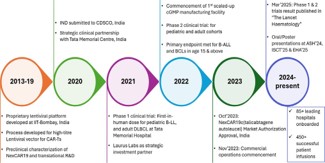
The origins of NexCAR19™ can be traced to collaborative research at IIT Bombay, where academic teams began developing indigenous CAR constructs. Recognizing the translational potential of this work, ImmunoACT, a start-up incubated at IIT Bombay, partnered with Tata Memorial Hospital to establish a pipeline for clinical translation (Figure 1). Early proof-of-concept studies in Indian patients demonstrated encouraging safety and efficacy results, providing the foundation for regulatory approval [7].
The partnership exemplified the value of academic–industry– hospital collaboration in LMICs. Academic laboratories contributed to scientific innovation, the industrial sector provided resources for scale-up and GMP compliance, and hospitals ensured clinical validation. This tripartite model enabled the transition of CAR-T therapy from bench to bedside within the Indian context.
Manufacturing models in LMICs: Adaptations
ImmunoACT had to adapt manufacturing processes to Indian realities. Initial production was conducted in a point-of-care model at Tata Memorial Hospital, leveraging hospital infrastructure for leukapheresis and cell processing. As the program advanced, ImmunoACT developed dedicated GMP-compliant facilities to scale production. A hub-and-spoke model was envisioned, with central hubs in major metropolitan cities serving regional hospitals. This approach balanced scalability with affordability, avoiding the inefficiencies of both extreme centralization and complete decentralization [8].
Key innovations included the development of indigenous viral vector production capacity, optimizing processes for scale, robust supply chains, and integrating digital tools for patients’ end-toend journey. These adaptations significantly lowered production costs while maintaining international quality standards [8].
Regulatory pathways and policy support
In India, the Central Drugs Standard Control Organization (CDSCO) under the Ministry of Health and Family Welfare oversees the regulatory approval of novel therapies, including CAR-T cell treatments. CDSCO is the central authority for evaluating new drug applications, including cell and gene therapies [9]. To support the development of gene therapy products, the Indian Council of Medical Research (ICMR) and the Department of Biotechnology (DBT) have jointly issued national guidelines outlining preclinical, clinical, and ethical requirements for such interventions. These guidelines emphasize rigorous assessment of safety, efficacy, and manufacturing standards [10]. By virtue of their genetic manipulation, CAR-T cell therapies require multiple regulatory clearances beyond CDSCO. These include approvals from the Institutional Biosafety Committee (IBSC), Review Committee on Genetic Manipulation (RCGM), and the Gene Therapy Advisory and Evaluation Committee (GTAEC) [11]. This multi-tiered framework ensures biosafety and ethical compliance at each stage of research and clinical translation.
India’s regulatory system demonstrated flexibility and commitment to innovation during the clinical development of Nex-CAR19™, the country’s first indigenous CAR-T product. CDSCO played a pivotal role by adapting global regulatory principles to Indian conditions and facilitating fast-track clinical evaluations. In parallel, BIRAC (Biotechnology Industry Research Assistance Council) provided critical translational support under the National Biopharma Mission (NBM). This included funding, infrastructure access, and strategic policy assistance, helping bridge academic research with clinical implementation [12]. Together, this collaborative ecosystem of regulatory and funding bodies has laid the foundation for the safe and efficient translation of CAR-T therapies in India.
The ImmunoACT experience highlights the importance of regulatory readiness in LMICs. Without frameworks that can adapt to advanced therapies, local innovation risks stagnation. India’s ability to establish a clear regulatory pathway expedited approval and built capacity for evaluating future cell and gene therapies.
Clinical development and outcomes
Phase I/II clinical studies of NexCAR19™ demonstrated outcomes comparable to international benchmarks. In patients with relapsed or refractory B-cell malignancies, the overall response rate exceeded 70%, with complete remissions observed in a significant proportion. Notably, the safety profile was favorable, with lower rates of grade III CRS and negligible ICANS than those reported in some global trials [13].
These results underscore that locally developed CAR-T products can achieve international efficacy and safety standards. Moreover, the reduced cost of NexCAR19™, estimated at ~10% of imported products, made it accessible to a broader patient population.
Lessons from the ImmunoACT experience
The journey of NexCAR19™ offers several key lessons for LMICs:
Integrated translational pathway
The development and commercial launch of NexCAR19™ illustrate how a locally anchored program can move an advanced therapy from proof-of-concept to routine clinical use in a resource-constrained setting. At the center of this trajectory was a deliberate alignment of science, manufacturing, regulation, and clinical practice. Rather than treating these domains as sequential hand-offs, the program integrated them from the outset, which shortened iteration cycles, reduced avoidable costs, and kept the product design responsive to clinical realities in India.
Academic–industry partnership
A first lesson concerns the structure and discipline of academic–industry partnerships. Innovation accelerated when discovery efforts at the university were coupled with an industrial team capable of translating protocols into GMP-ready processes and documentation. Joint governance (shared technical reviews, cross-functional working groups, and integrated data rooms) helped reconcile academic curiosity with manufacturability and regulatory expectations. Notably, the collaboration was bidirectional: clinical observations fed back to the construct and process design teams. In contrast, process constraints informed the scope of laboratory optimization, producing a development loop that was both scientifically rigorous and engineering-aware.
Cost innovation through localized manufacturing
Cost innovation was not a single intervention but an accumulation of compounded choices. Indigenous manufacturing of viral vectors cuts reliance on imported materials and logistics that typically dominate the cost of goods in LMICs. Standardizing media, disposables, and analytical assays reduced batch-to-batch variability and simplified supply chains. Just as significant were “invisible” efficiencies: right-sizing cleanroom classifications to the risk profile of each unit operation, deploying a digital quality-management backbone to limit paper rework, and designing release testing panels that were robust yet parsimonious. Together, these steps preserved quality while bending the cost curve to levels compatible with domestic reimbursement.
Scalable manufacturing architecture: Hub-and-spoke with harmonized controls
Manufacturing architecture was another determinant of scalability—a hub-and-spoke configuration balanced economies of scale with geographic access. The model worked because it was accompanied by process control strategies that travel well: harmonized SOPs, common operator training and qualification, calibrated instruments, and centrally monitored in-process controls. Chain-of-identity and chain-of-custody were digitized end-toend, minimizing handoff errors and enabling real-time deviation management across sites. This approach avoided the fragility of complete decentralization while preventing the long vein-to-vein times and logistics costs typical of global centralization [8].
Regulatory and policy enablement
Regulatory and policy support functioned as an enabling scaffold rather than a final gate. Early scientific advice with the national regulator aligned study designs, comparability expectations, and safety monitoring plans with international norms while acknowledging local constraints. Grant-based de-risking of translational steps and targeted capital support for GMP infrastructure compressed timelines that would otherwise stretch over years. The experience underscores that regulatory readiness in LMICs is not synonymous with deregulation; it is about timely, sciencebased pathways, predictable review cycles, and clear post-approval commitments that create investable certainty.
Clinical integration and real-world evidence generation
Finally, clinical integration was essential for credibility and uptake. Embedding the program in leading cancer centers ensured access to apheresis, intensive care, and multidisciplinary teams experienced with cytokine-release syndrome and neurotoxicity management. Prospective data capture, pharmacovigilance, and real-world evidence generation were treated as core deliverables, not afterthoughts, allowing continuous refinement of patient selection, bridging therapy, and toxicity protocols. Equally important were patient-access mechanisms (tiered pricing, philanthropic support, and public-sector engagement) that matched manufacturing affordability with financial feasibility at the bedside [14].
A systems blueprint for LMICs
These lessons argue for a systems view of CAR-T translation in LMICs. Successful programs combine partnership design, cost-aware process engineering, scalable manufacturing topology, science-based regulation, and clinically grounded delivery. The ImmunoACT experience shows that when these elements are developed in concert, an indigenous product can reach commercial scale without compromising quality, setting a replicable template for other LMICs aiming to build sustainable cell-therapy ecosystems [8].
Future directions for CAR-T in India
The launch of NexCAR19™ is only the beginning. Future priorities include expanding CAR-T indications to solid tumors, improving persistence and durability of responses, and integrating nextgeneration constructs with safety switches and dual targeting. Innovations in in vivo CAR-T generation, particularly lipid nanoparticle–based delivery of CAR constructs, may eventually bypass the need for ex vivo manufacturing [15,16].
India also has the opportunity to lead in global south collaborations, sharing its experience with other LMICs. By building regional manufacturing hubs and harmonizing regulatory pathways, LMICs can collectively accelerate access to CAR-T therapy.
Conclusion
The commercial-scale launch of NexCAR19™ represents a milestone achievement in global oncology, demonstrating that CAR-T cell therapy is feasible outside the confines of high-income healthcare systems. India has developed a sustainable model for delivering advanced therapies in resource-limited settings by employing academic innovation, industry partnerships, and policy support. The ImmunoACT experience provides a roadmap for other LMICs, proving that transformative therapies can be adapted to diverse healthcare ecosystems. The future of CAR-T therapy will depend on how these lessons are applied globally to ensure equitable access for patients everywhere.
References
- De Marco RC, Monzo HJ, Ojala PMJ. CAR T cell therapy: a versatile living drug. Int J Mol Sci. 2023; 24: 6300.
- June CH, et al. CAR T cell immunotherapy for human cancer. Science. 2018; 359: 1361–1365.
- Islam N, et al. Disparities in clinical trial enrollment – focus on CART and bispecific antibody therapies. Curr Hematol Malig Rep. 2024; 20: 1.
- Wang V, et al. Systematic review on CAR-T cell clinical trials up to 2022: academic center input. Mol Ther Oncolytics. 2023; 15: 1003.
- Dwivedi A, et al. Robust antitumor activity and low cytokine production by novel humanized anti-CD19 CAR T cells. Mol Cancer Ther. 2021; 20: 846–858.
- Ali SA, et al. T cells expressing an anti-B-cell maturation antigen chimeric antigen receptor cause remissions of multiple myeloma. Blood. 2016; 128: 1688–1700.
- Karulkar A, et al. Making anti-CD19 CAR-T cell therapy accessible and affordable: first-in-human phase I clinical trial experience from India. Blood. 2022; 140: 1–1.
- Karulkar A, et al. Development of equitable access model for nationwide implementation of affordable CAR-T cell therapy in India: a real-world experience. Blood. 2025; 27: S13–S14.
- Dalal V, et al. Gene therapy in India: developments, challenges, and future directions. Gene Ther. 2023; 30: 1–1.
- Chepuri GA, Sanjayrao Mude G. Regulatory process and considerations for gene therapy clinical trials in India. Quest J. 2023; 9: 9.
- Rao MVV, et al. Clinical Trials Registry–India: an overview and new developments. Perspect Clin Res. 2018; 50: 208–211.
- Hotchandani H, et al. Implementation of a CAR-T cell therapy program in India. Expert Rev Anticancer Ther. 2025; 25: 599–608.
- Jain H, et al. Talicabtagene autoleucel for relapsed or refractory Bcell malignancies: results from an open-label, multicentre, phase 1/2 study. Lancet Haematol. 2025; 12: e282–e293.
- Jain H, et al. Real world data of novel talicabtagene autoleucel (humanized CD19 CAR-T) from India: ensuring equitable access with excellent safety and efficacy profile. Blood. 2024; 144: 3755.
- Bimbo JF, et al. T cell-specific non-viral DNA delivery and in vivo CAR-T generation using targeted lipid nanoparticles. J Immunother Cancer. 2025; 13: 1.
- Billingsley MM, et al. In vivo mRNA CAR T cell engineering via targeted ionizable lipid nanoparticles with extrahepatic tropism. Small. 2024; 20: e2304378.