Materials and methods
A prospective observational study was conducted involving 124 oncology patients (64 women and 60 men; mean age — 62.4±8.7 years) who received inpatient and outpatient treatment at the oncological departments of the Samarkand State Medical University and the Samarkand Interregional Hospice.
Inclusion criteria:
- Confirmed malignant neoplasm (stage II–IV according to the TNM classification);
- Absence of severe hepatic or renal failure;
- Ability to perform functional tests;
- Provision of informed consent by the patient.
Exclusion criteria:
- Active inflammatory or infectious diseases;
- Pronounced edema, ascites, or limb amputation (which prevent accurate measurement of muscle mass);
- Decompensated somatic or psychiatric disorders.
Table 1: Distribution by tumor localization.
| Tumor localization |
Number of patients (n) |
Percentage (%) |
| Breast cancer |
34 |
27.4% |
| Gastric cancer |
26 |
21.0% |
| Colorectal cancer |
19 |
15.3% |
| Lung cancer |
14 |
11.3% |
| Ovarian and uterine body cancer |
11 |
8.9% |
| Pancreatic cancer |
8 |
6.5% |
| Prostate cancer |
7 |
5.6% |
| Head and neck tumors (larynx, oropharynx, etc.) |
5 |
4.0% |
| Total |
124 |
100% |
Note: In 81% of patients, locally advanced and metastatic forms (stage III–IV) were diagnosed, which determined a high risk of sarcopenia and cancer cachexia.
Assessment of sarcopenia was carried out in three stages:
- Muscle strength (HGS) — handgrip dynamometry; three measurements were taken, and the highest value was recorded. Threshold values for low strength: <27 kg in men, <16 kg in women.
- Muscle mass (BIA) — bioelectrical impedance analysis (performed in the morning on an empty stomach). The skeletal muscle mass index (ASM/height²) was calculated.
- Functional performance — gait speed over 4 meters and the Short Physical Performance Battery (SPPB). Low physical performance was defined as a walking speed <0.8 m/s or an SPPB score ≤8 points.
Table 2: Distribution of patients according to the severity of sarcopenia.
| Severity of Sarcopenia |
No. of patients (n) |
Percentage (%) |
Main criteria |
| Mild (presarcopenia) |
42 |
33.9% |
Reduced muscle mass with preserved strength and normal physical performance |
| Moderate |
53 |
42.7% |
Reduced muscle strength and mass without significant limitation of activity |
| Severe (cachectic) |
29 |
23.4% |
Reduced muscle strength, mass, and physical performance (SPPB ≤ 8 or gait speed < 0.8 m/s) |
| Total |
124 |
100% |
— |
Additional parameters:For each patient, the following data were recorded:
- Anthropometric and clinical indicators: Body Mass Index (BMI), disease stage (TNM), and functional status (ECOG).
- Laboratory parameters: serum albumin, C-Reactive Protein (CRP), interleukin-6 (IL-6), hemoglobin, and creatinine levels.
- Oncological treatment characteristics: type of anticancer therapy (surgery, chemotherapy, radiotherapy, targeted therapy, or immunotherapy).
Individualized therapeutic approaches by severity:
- Mild sarcopenia: high-protein diet (≥1.2 g/kg/day), vitamin D supplementation, omega-3 polyunsaturated fatty acids, and low-intensity physical exercise (therapeutic training 2–3 times per week).
- Moderate sarcopenia: combined nutritional support (1.3–1.5 g/kg/day), administration of megestrol acetate in cases of anorexia, anabolic rehabilitation of moderate intensity, correction of anemia and vitamin D deficiency.
- Severe sarcopenia: predominantly palliative approach — sip feeding at 30–35 kcal/kg/day, megestrol acetate ± prednisolone, correction of electrolyte imbalances, symptom control, and psychological support.
Discussion
The results of this prospective study, which included 124 oncological patients with various tumor localizations, confirm the high prevalence of sarcopenia and its significant dependence on tumor localization, cancer stage, and overall patient condition.
The highest frequency of moderate and severe sarcopenia was observed in patients with gastric (73.1%), pancreatic (75.0%), and colorectal cancers (68.4%). These tumor types are characterized by pronounced nutritional disorders, malabsorption, and chronic inflammation, which accelerate protein catabolism and lead to a progressive decline in skeletal muscle mass.
In contrast, patients with breast cancer and gynecological malignancies predominantly presented with mild forms of sarcopenia (up to 60%), which may be explained by better compensatory mechanisms and a lower frequency of systemic metabolic complications.
Thus, tumor localization can be considered one of the key risk factors for sarcopenia development, determining its pathogenetic profile and clinical prognosis. These findings are consistent with previous studies by Baracos V.E. [1] and Fearon K. [4], which emphasized the dominant role of visceral malignancies in the formation of cancer cachexia.
Within the examined cohort, moderate sarcopenia predominated (42.7%), while severe (cachectic) forms were diagnosed in 23.4% of cases. The findings demonstrate that even moderate reductions in handgrip strength and muscle mass are associated with decreased tolerance to anticancer therapy and an increased rate of complications. Patients with severe sarcopenia were more likely to have stage III–IV disease and a low functional status (ECOG ≥2), confirming the relationship between tumor progression and the degree of muscle wasting.
Among patients with moderate and severe sarcopenia, significantly elevated levels of IL-6 (20–25 pg/mL) and CRP (>10 mg/L) were observed, along with reduced serum albumin (<34 g/L). These changes reflect the activation of a systemic inflammatory response, which serves as a major trigger for hypercatabolism and myofibrillar degradation. According to current concepts [3,6], chronic tumor-associated inflammation activates cytokine cascades (IL-6, TNF-α), leading to suppression of protein synthesis and the development of anabolic resistance.
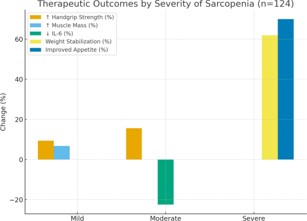
The application of stratified therapeutic approaches demonstrated a positive clinical effect in all groups, although the degree of improvement depended on sarcopenia severity:
In patients with mild sarcopenia, an 8-week course resulted in a 9.4% increase in handgrip strength (p<0.05) and a 6.8% gain in muscle mass.
In the moderate group, 12-week combination therapy (nutritional support, megestrol acetate, omega-3 polyunsaturated fatty acids, and physical activation) achieved a 15.6% increase in handgrip strength and a 22.4% reduction in IL-6 levels.
In patients with severe sarcopenia, a palliative therapeutic strategy led to body weight stabilization in 62% and improved appetite in 70%, accompanied by a subjective improvement in quality of life.
Overall, the effectiveness of sarcopenia correction directly correlated with its severity: at early stages, the process is partially or fully reversible, while in the cachectic phase, therapy primarily serves a supportive and palliative role aimed at improving wellbeing and maintaining quality of life.
Conclusions of the discussion
The findings of this study confirm the importance of early diagnosis of sarcopenia in cancer patients, particularly in those with gastrointestinal malignancies, where the risk of muscle wasting is most pronounced.
The use of EWGSOP2 diagnostic criteria ensures a standardized assessment of muscle mass and function, which is essential for monitoring the dynamics of sarcopenia during oncological treatment.
Incorporating nutritional and functional correction into the structure of comprehensive oncological care improves tolerance to chemotherapy, reduces the incidence of treatment-related complications, and contributes to better overall survival, in line with international meta-analyses [1,5].
Sarcopenia was detected in the majority (over 70%) of patients with advanced malignant tumors.
The most pronounced manifestations were observed in visceral localizations — stomach, pancreas, and colorectal cancer.
The severity of sarcopenia determines the therapeutic strategy: from nutritional prevention at early stages to palliative correction in severe forms.
Early stratification of patients according to sarcopenia severity increases the effectiveness of anticancer therapy and improves quality of life outcomes.
References
- Baracos VE, Martin L, Korc M, Guttridge DC, Fearon KCH. Cancerassociated cachexia. Nat Rev Dis Primers. 2018; 4: 17105.
- Baracos VE, Arribas L, Prado CM. Sarcopenia in cancer: clinical outcomes and therapeutic perspectives. Nat Rev Clin Oncol. 2022; 19: 401-421.
- Cruz-Jentoft AJ, Bahat G, Bauer J, Boirie Y, Bruyère O, Cederholm T, et al. Sarcopenia: revised European consensus on definition and diagnosis (EWGSOP2). Age Ageing. 2019; 48: 16-31.
- Fearon K, Strasser F, Anker SD, Bosaeus I, Bruera E, Fainsinger RL, et al. Definition and classification of cancer cachexia: an international consensus. Lancet Oncol. 2011; 12: 489-495.
- Shachar SS, Deal AM, Weinberg M, Nyrop KA, Williams GR, Nishijima TF, et al. Skeletal muscle measures as predictors of toxicity, hospitalization, and survival in patients with metastatic cancer receiving chemotherapy. Cancer. 2021; 127: 1210-1219.
- Prado CM, Heymsfield SB. Lean tissue imaging: a new era for nutritional assessment and clinical management. J Clin Oncol. 2020; 38: 2110-2123.
- Caan BJ, Cespedes Feliciano EM, Prado CM, Alexeeff S, Kroenke CH, Bradshaw P, et al. Association of muscle and adiposity measured by computed tomography with survival in patients with nonmetastatic breast cancer. JAMA Oncol. 2018; 4: 798-806.
- Chen LK, Woo J, Assantachai P, Auyeung TW, Chou MY, Iijima K, et al. Asian Working Group for Sarcopenia: 2019 consensus update on sarcopenia diagnosis and treatment. J Am Med Dir Assoc. 2020; 21: 300-307.
- Ryan AM, Prado CM, Sullivan ES, Power DG, Daly LE, Cushen SJ. Cancer-associated malnutrition, cachexia and sarcopenia: the skeleton in the hospital closet 40 years later. Proc Nutr Soc. 2019; 78: 517-525.
- Argilés JM, Busquets S, Stemmler B, López-Soriano FJ. Cancer cachexia: understanding the molecular basis. Nat Rev Cancer. 2015; 14: 754-762.