Introduction
The cancer burden in India is drastically increasing [1]. Many patients present in advanced stage at the time of diagnosis, due to undue delay in seeking medical attention. There are various factors which may result in delayed patient presentation and can be categorized into personal, socio-cultural and economic factors [2]. These include lack of awareness of symptoms, fatalist beliefs, fear of cancer diagnosis and societal stigma against people living with cancer [3]. The advanced stage of presentation not only affects the overall survival but also makes these patients at a higher risk for early recurrences, in spite of complete treatment. So, early detection is an important aspect in the treatment of cancer patients which will ensure long term survival along with good quality of life.
The socio-economic factors which delay the stage of disease at the time of presentation include anxiety, lack of awareness, cost of medical care, educational status and income status. Amongst these, the educational status of the patients has been reported to play a significant role in the stage of presentation [4]. Knowledge gaps are also a key factor impacting an individual’s ability to manage their cancer diagnosis, treatment and side effects. Health behavior theories suggest that people are more likely to adhere to treatment protocols when they understand the disease and treatment [5]. Even though the literacy rates in India have been steadily increasing after independence from 18% to 74%, our population has also bloomed from 361 million to 1210 million during this time period [6]. The literacy rates also vary among different states across the country. Kerala at 96.2% is the state with the highest literacy rate, while Andhra Pradesh has a literacy rate of 66.4%; the lowest among all states in the country [6]. Also, the educational opportunities and medical facilities are not uniform across our country.
There are several studies which have correlated poor educational status with delay in presentation of breast cancer. A retrospective analysis conducted at the Tata memorial hospital, Mumbai, included 1210 breast cancer patients and analysed the various socioeconomic factors and concluded that patients of rural background and low education status are more likely to have advanced stage during their presentation [7].
The main objective of our study was to analyse the role of educational status in stage of cancer presentation for different cancer subtypes.
Subjects and methods
Study design
This is a retrospective analysis of a prospectively maintained database from the hospital-based cancer registry, Thangam cancer centre, Namakkal, Tamil nadu, India.
Study population
Cancer patients reporting to our hospital between 2018-2021 were analyzed for the study. Amongst the data of 3166 patients, 760 patients had missing data, and hence were excluded. Finally, we had data of 2406 patients for our analysis. The educational status was qualified as; low (illiterate,
Statistical analysis
The categorical variables were analysed with descriptive analysis and represented as frequencies and percentages. ‘Chi square’ test was used to test the statistical significance of cross tabulation between categorical variables and p<0.05 was considered statistically significant. Data was analysed by using coGuide software. (BDSS Corp. Released 2020. coGuide Statistics software, Version 1.0, India: BDSS corp.).
Results
The demographic details of the patients are presented in table
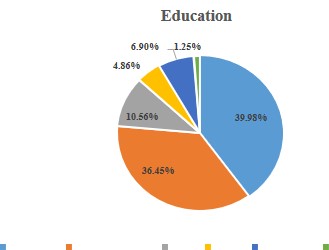
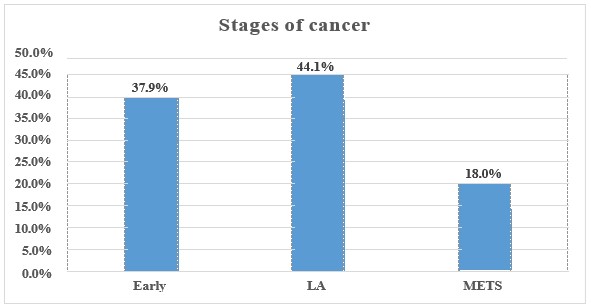
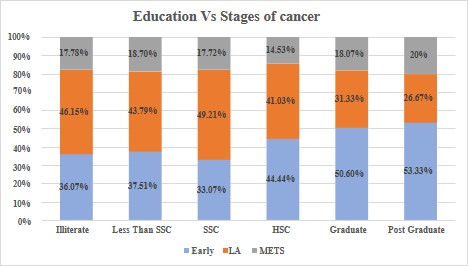
1. The educational status of the patients included in the study is reported in table 2 (Figure 1). The various stages at presentation, are reported in table 3 (Figure 2). Among graduates and post- graduates, >50% presented in early stage of cancer. Among patients whose education was HSC, around 44% presented in early stage of cancer. Among patients whose education was SSC and/ or below, <40% presented in early stage of cancer. A statistically significant difference was noted in the stage of presentation and the educational status of the patients (p<0.05) table 4.
Table 1: Baseline characteristics in the study population (N=2406).
| Variables |
Summary statistics |
| Age (years) |
| Mean±SD |
57.02±12.36 |
| Median (IQR) |
58(49 to 65) |
| Range |
8 to 98 |
| Gender |
| Male |
636(26.4%) |
| Female |
1770(73.6%) |
| Site of cancer |
| Bladder cancer |
29(1.2%) |
| Breast cancer |
765(32.8%) |
| Cervix cancer |
419(17.4%) |
| Colo-rectal and anal canal cancer |
127(5.3%) |
| Endometrial cancer |
124(4.3%) |
| Esophageal cancer |
102(4.2%) |
| Gall Bladder cancer |
39(1.6%) |
| Larynx, Hypopharynx, Nasopharynx |
98(3.8%) |
| Lung cancer |
188(8.8%) |
| Oral cavity |
201(8.5%) |
| Ovarian cancer |
77(2.8%) |
| Pancreatic cancer |
31(1.3%) |
| Penile cancer |
19(0.8%) |
| Prostate cancer |
37(1.5%) |
| Renal cancer |
27(1.1%) |
| Stomach cancer |
72(2.7%) |
| Thyroid cancer |
51 (1.9%) |
Table 2: Education of the study population (N=2406).
| Education |
Frequency |
Percentages |
| Illiterate |
962 |
39.98% |
| Less than SSC |
877 |
36.45% |
| SSC |
254 |
10.56% |
| HSC |
117 |
4.86% |
| Graduate |
166 |
6.90% |
| Post Graduate |
30 |
1.25% |
Table 3: Stage of cancer of the study population (N=2406).
| Stage |
Frequency |
Percentages |
| Early |
912 |
37.9% |
| Locally advanced |
1061 |
44.10% |
| Metastatic |
433 |
18.00% |
Table 4: Comparison of stage of cancer according to education of the study population.
| Education |
Stage |
p-value |
| Early |
Locally advanced |
Metastatic |
| Illiterate (n=962) |
347(36.07%) |
444(46.15%) |
171(17.78%) |
0.006
|
| Less Than SSC (n=877) |
329(37.51%) |
384(43.79%) |
164(18.7%) |
| SSC (n=254) |
84(33.07%) |
125(49.21%) |
45(17.72%) |
| HSC (n=117) |
52(44.44%) |
48(41.03%) |
17(14.53%) |
| Graduate (n=166) |
84(50.6%) |
52(31.33%) |
30(18.07%) |
| Post Graduate (n=30) |
16(53.33%) |
8(26.67%) |
6(20%) |
Discussion
In this study, 17 types of cancer subtypes were analyzed and the role of educational status of the patient was co-related with the stage at diagnosis. Our study showed that patients with higher educational qualification, more often presented with early stage; 962 patients out of 2406, were illiterate and among them only 36% were at the early stage during the time of presentation, as compared to 50% with early stage among the patients with higher educational status. This is in accordance with a previous study which correlated the educational status and cancer stage at diagnosis for breast, cervical and oral cavity cancers in Trivandrum District. Among 4,547 patients, they reported that 1010 patients were illiterate/ with primary school education and only 40% of them presented at an early stage [8].
A nationwide, multicenter 10-year epidemiological study, conducted in China, concluded that the occupation and educational status had a significant impact on TNM staging of patients presenting with breast cancer [9]. Similar data exists from a population-based study, conducted in South India which established that patients from lower educational background are more likely to be diagnosed with advanced-stage of cancer and to have inferior survival [8]. Thus, there is a strong co-relation between educational status and cancer stage at the time of diagnosis.
Also, it is known that the stage at diagnosis, significantly affects the survival outcome of patients. A population-based cancer study was conducted in total 17,331 breast cancer patients who were diagnosed between 2012 and 2015 and were followed up till 2021. The 5- year observed survival rates for localized, regional, and distant metastasis in these patients were 81.0%, 65.5%, and 18.3%, respectively [10]. The advanced stage at presentation also increases the intensity and duration of treatment, thereby adding to the financial burden, in an already existing lower social economic strata of patients. The need for multi- modality treatment, also adds further cost to the resource constrained health care system. It is thus, important to understand the significance of educating our population, to get cancers diagnosed at an earlier stage and thus attempt to reduce the mortality from various cancer subtypes.
Our study has few limitations; there are so many other factors other than educational status which cause delay in presentation and treatment outcomes of the patients; the economical status, the age of presentation, site of cancer and the most notorious, the tumor biology. We need to analyse these factors, as well, to understand them better and hence to try and improve the outcome of these patients.
Conclusion
Thus, educational status plays a significant role in the cancer stage at the time of diagnosis. With increasing access to educational opportunities, complemented by various cancer awareness programs conducted across the country, we hope that our patients present at an early stage and have improved survival with good quality of life.
References
- Bray F, Laversanne M, Sung H, et al. Global cancer statistics 2022: GLOBOCAN estimates of incidence and mortality worldwide for 36 cancers in 185 countries. CA Cancer J Clin. 2024; 74: 229–263.
- Sharma K, et al. Systematic review of barriers to breast cancer care in developing countries resulting in delayed patient presentation. J Oncol. 2012; 2012: 121873.
- Nnaji CA, Kuodi P, Walter FM, Moodley J. Timeliness of diagnosis of breast and cervical cancers and associated factors in low-income and middle-income countries: a scoping review protocol. BMJ Open. 2021; 11: e044093.
- Christiansen K, Buswell L, Fadelu T. A systematic review of patient education strategies for oncology patients in low- and middle- income countries. Oncologist. 2023; 28: 1.
- Amico KR, Mugavero M, Krousel-Wood MA, Bosworth HB, Merlin JS. Advantages to using social-behavioral models of medication adherence in research and practice. J Gen Intern Med. 2018; 33: 207–215.
- O’Neill A. Literacy rate in India. Statista. 2024.
- Sathwara JA, Balasubramaniam G, Bobdey SC, Jain A, Saoba S. Sociodemographic factors and late-stage diagnosis of breast cancer in India: A hospital-based study. Indian J Med Paediatr Oncol. 2017; 38: 277–281.
- Mathew A, et al. Educational status, cancer stage, and survival in South India: A population-based study. JCO Glob Oncol. 2020; 6: 1704–1711.
- Li J, et al. A nation-wide multicenter 10-year (1999–2008) retrospective clinical epidemiological study of female breast cancer in China. BMC Cancer. 2011; 11: 364.
- Sathishkumar K, Sankarapillai J, Mathew A, Nair RA, Gangane N, Khuraijam S. Breast cancer survival in India across 11 geographic areas under the National Cancer Registry Programme. Cancer. 2024; 130: 1816–1825.